Yearly experiences
13,000+
Experiences published across spirits, CPG, retail, and entertainment brands.
Experience Manager is the surface operators use every day: creating experiences, managing bookings, handling walk-ups, and capturing first-party data from every guest on every booking. It powers over 13,000 experiences and reaches 1.3M users a year. This sub-page is the deep dive on how it was designed to do that.
The person creating a ticketed whisky tasting at a distillery isn't a product manager. They're the brand ambassador who's also running the tour, answering guest questions, and setting up the tasting table. The creation flow had to get from nothing to fully published, with tickets, capacity, scheduling, and media, without a training session.
Four required steps cover everything an operator needs to go live: About (name, description, category, and optional translations), Tickets (types, pricing, add-ons, and payment rules), Scheduling (time slots, capacity, and booking preferences), and Media (the cover photo that gates publishing). Advanced settings (Resources, Checkout Questions, Online Booking Preferences, and Email Customizations) are present but out of the critical path. An operator can be live in minutes, or spend an hour on the details. The flow handles both.
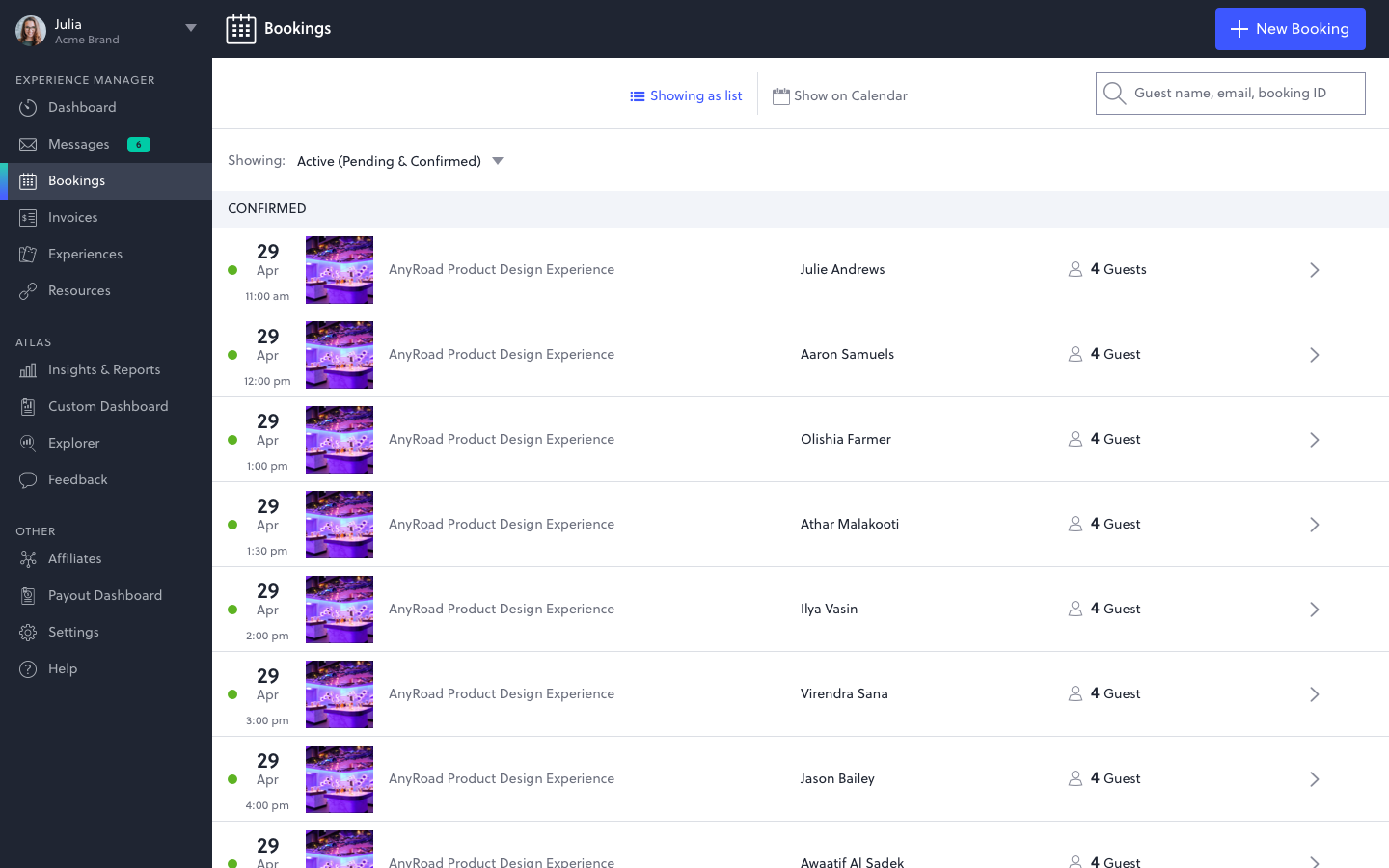
Most operators use the bookings surface to do one of three things: check who's confirmed for a given date, track down a guest who can't find their booking, or sort out something that went wrong with payment. The list view and detail view are designed around those jobs.
Underneath, a booking moves through many states between initiated and complete, each with different side effects and available actions. The interface doesn't expose that. It shows one readable status at each moment and surfaces only the controls that apply to it. A booking that needs attention looks different from one that doesn't.
A guest arrives at the distillery without a reservation. There's no published time slot in the next hour. A group of eight shows up to the bourbon tour but they want the brandy tour instead. These are real operational moments that happen every day at hundreds of venues, and they used to mean improvising: taking payment offline, manually updating records later, or turning guests away.
Walk-up booking creates a time slot on the fly and attaches a booking to it in a single flow. Transfer to a new experience auto-maps ticket types and reconciles the price difference on the original card. The entire flow runs on a phone, so whoever is closest to the guest can resolve it on the spot.
Before FullView, a booking submitted by John Smith with three additional guests gave the operator exactly one guest record: John's. The other three walked in for the whisky tasting as strangers. When they submitted post-visit NPS feedback, that feedback couldn't be tied to a named guest profile, a ticket type, or a segment. The attribution chain broke at the front door.
FullView captures checkout questions, feedback, and marketing opt-ins from every guest on a booking, not just the booker. The booking guest collects additional guest names during checkout; a sharing link then reaches those guests with the same questions they would have seen if they'd booked directly. The data lands in Atlas, attributed to the right guest, and feeds Explorer segments and Pinpoint analysis. It's the capability AnyRoad's competitors don't have, and the one that makes the analytics layer meaningful at scale.
Experience Manager isn't a content management tool bolted to a booking engine. The surfaces compose: a question configured in the creation wizard populates Atlas the moment a guest responds. A booking reschedule updates Atlas capacity without a manual sync. A FullView completion from an additional guest attributes directly to the segment an Explorer query returns. The chain is legible end to end.
The principle that held it together was designing against the operator's day, not the feature list. A distillery brand ambassador creates a new experience in the morning, manages walk-up bookings in the afternoon, and reviews guest completions that night. Experience Manager follows that arc (create, operate, capture) as a single instrument, not four tools.
— Platform-wide numbers via AnyRoad · Full context on parent case
A 13-state booking machine has to work correctly in engineering and invisibly in the interface. The design work wasn't exposing the states; it was deciding which states the operator ever needs to name. The answer was three: confirmed, pending, and something's wrong. Everything else is an implementation detail that the platform handles, and the interface acknowledges through available actions, not visible labels.
Advanced Settings in the creation wizard exists because sophisticated operators need Resources, conditional Checkout Questions, and per-channel Email Customizations. But surfacing those in the critical path would have turned a four-step flow into a twenty-step one for the brand ambassador who just needs to go live. The tension between power and simplicity is never resolved; it's managed, one flow decision at a time.
The value of FullView is that it extends first-party data capture to every seat on a booking. But that value only lands if additional guests actually complete the sharing link. The design of that link (what it asks, how it's framed, when it arrives) determines whether the data model is full or empty. Platform design and product design were the same problem.